
Written in in the fall/winter of 2023 and edited in the spring of 2024, submitted to the College Board for AP Seminar
A 2014 Health Services Research article found that “ . . . New Jersey, Maryland, Florida, Arizona, and New York were the states with the highest health care value . . . [and] Alaska, Montana, Mississippi, Wyoming, and Vermont were the states with the lowest health care value . . .” (Dielman et al. 4-5). The American ambition to be the best will have many people reading this statistic to find their state. This is what has fueled so many current debates about the value and availability of US healthcare; if there is a flaw in the country it is harder to have pride and nationalism within it. Very little research focuses on the actual development and worth of the system and instead joins the political debate of who should be granted access to this system. With how much is put towards medical advancement in the USA, people expect high levels of care but have always been met with disproportionate statistics concerning the quality. After over 200 years of history as a country and public surveys, why does the government invest so much into healthcare with unrewarding results? The US prioritizes its healthcare system for the purpose of political gain rather than wanting improvement for the American peoples’ health.

“Yvonne Tanner, a nurse practitioner at Itta Bena Clinic in the Mississippi Delta.” Photo from the New York Times article “How Do We Fix The Scandal That Is American Healthcare?” written by Nicholas Kristof and Photographs taken by September Dawn Bottoms
Medical support is written into the founding of the US and was reconfirmed in “The first clause of Article 25 of the Universal Declaration of Human Rights, adopted by the United Nations in 1948 and signed by the United States, [it] reads: Everyone has the right to a standard of living for the health and wellbeing of himself and of his family, including . . . medical care” (McElfish 4). Yet it seems that this declaration did not stand the test of time; less than 100 years later “The number of US children without health insurance increased by 400,000 between 2016 and 2018, largely due to rollbacks of federal government health programs, according to a report by the Georgetown University Center for Children and Families” (Barna 1). This may be excused with the assumption that the American government has strayed and forgotten the decades long promise. Contrastingly, it seems that the right to medical care has been forgotten since 1997 when a health policy journal, The Milbank Quarterly, estimated “ . . . that 43 million individuals under 65 had no health insurance . . . This reflects 18.3 percent of the population under 65. Fifteen percent of all children are uninsured” (Gold 3). The government claims to release honest and full reports for the betterment of the public but the reports and numbers speak louder than the words they signed under in 1948. The US government may leave these incriminating numbers to be conveniently forgotten, but America is known for extensive spending statistics. A US Commonwealth Fund survey compared Germany, New Zealand, the UK, Australia, and Canada’s healthcare funding with their quality of care; a German media company specializing in scientific documents published the findings of the survey in 2020:
“The amount spent in healthcare per person in the US [is] $US5635 . . . However the US ranked the lowest in four of six categories evaluating healthcare quality . . .” (“Although the US Spends”).
Ironically, a research article funded by Stanford Clinical Excellence Research Center released their results in the official journal of AcademyHealth; “ . . . that increases in Medicare prescription drug plan premiums and increases in Medicaid income eligibility were significantly associated with increases in value . . . A 10% increase in Medicaid income eligibility for children . . . was associated with a[n] . . . increase in health care value” (Dielman et al. 5). But this is not the only research that highlights the expansion of government medical support. In 2017, a “ . . . study, published in February in Women’s Health Issues, . . . A Centers for Disease Control and Prevention database was used to examine records from CDC’s National Center for Health Statistics between 2006 and 2017. Researchers found an association between Medicaid expansion and fewer maternal deaths based on women deaths during pregnancy and up to 42 days after delivery. In expansion states, there were 7.1 fewer maternal deaths out of 100, 000 patients as compared to nonexpansion states” (Barna 1). Although nothing has been made to alter the first clause in Article 25 of Universal Independence and the American right to medical support, two seperate statistics show the lack of progress to change America’s low quality healthcare ranking. Other sources show the positive impact if government sourced Medicaid and Medicare, but funding is still rolled back from these providers by the government that signed and promised to supply medical security for the people.
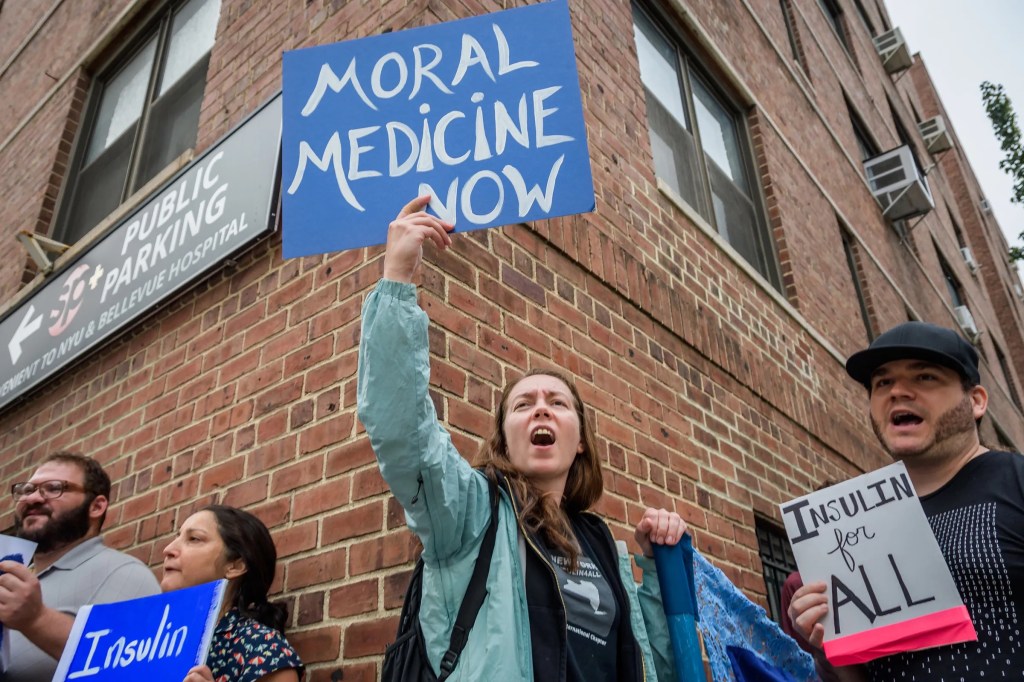
“Advocates with T1Internationals New York, New Jersey, and Connecticut Chapters hold a vigil in New York City, on Sept. 5, 2019, honoring those who have lost their lives due to the high cost of insulin and demand lower insulin prices” Photo taken by Erik McGregor and from the New York Times article “How Healthcare Costs Hurt American Workers and Benefit The Wealthy” written by Anne Case and Angus Deaton
A dog performs what he is trained to perform, a computer acts by its code, and a professional works how he was taught. By this pattern, the US healthcare system cannot change until the ethics of their political priorities is addressed in the classroom. Several social science professionals sought better US health care through interprofessional teachings; they emphasize
“ . . . growing challenges with medical error and patient safety, most frequently attributable to system and communication failures . . . A study by researchers at John Hopkins Medicine found medical errors to be the third leading cause of death in the United States . . .” (Rubin et al. 2).
The goal of the investigation was to achieve quality care which can be defined by the National Academy of Medicine: “ . . . that it be safe, effective, patient-centered, timely, efficient, and equitable” (Sage 5). The social science researchers thought to implement this level of success, “Quality care . . . cannot be adequately achieved when even high-level competencies are learned in a vacuum. Collaborative competencies must be understood and delivered within the context and exigencies of real people’s lives” (Rubin et al. 6). In fact, this solution can boast “ . . . that practice settings implement[ing] team-based practice models . . . [have] been seen in Australia, Canada, and New Zealand” (Rubin et al. 2). Referring back to the US Commonwealth Fund, the overall healthcare quality survey placed Germany in first, “ . . . followed by New Zealand, the UK, Australia, then Canada” (“Although the US Spends”). America evidently landed in last being the only country not named in the top five of six countries. Not only does this study see overall quality improvement that can be shown through international surveys, “Knowing how to communicate across professions seems to facilitate improvements in medication management, reduce fall risks, and decrease the number or return visits to primary care and emergency departments“ (Rubin et al. 8). Addressing medical teaching and practice is shown to promote quality and safe treatment in first world nations and may have the opportunity to provide the American citizens with their government’s promised obligation of effective healthcare.
“One quote from Mr. Ameringer’s book [‘U.S.Health Policy and Health Care Delivery: Doctors, Reformers, and Entrepreneurs’] that stuck with me was a citation from Lawton Burns and Ralph Muller, stating: ‘Societal goals are clearly not in the primary aim of economic integration. . . [R]evenue and income goals of providers seem to be the dominant motivation.’ Perhaps a new focus of health care integration is needed before the issues of cost and access can be addressed?” (Meyers).
Frank Meyers’, Executive Director of the District of Columbia Board of Medicine, book report touches on America’s health care history and comes to a conclusion similar to the studies previously reported. Limitations of such a solution appear in the fact of free will; in 2017, “Most smokers at high risk for lung cancer from years of cigarette smoking fail to follow recommendations that they be screened annually . . .” (Barna). You cannot help someone who doesn’t want to be helped and that will restrict the government from being able to fully secure the entire nation’s care. Something is better than nothing, especially concerning the high American spending budget and the low quality healthcare; the US may yet join other developed countries in quality care with altered priorities in medical practice teachings.
Works Cited
“Although the US Spends More per Patient on Healthcare, Compared with Five Other Developed Countries, This Does Not Correlate with Higher Quality of Care.” PharmacoEconomics & Outcomes News, no. 503, May 2006, p. 20. EBSCOhost, search.ebscohost.com/login.aspx?direct=true&db=asn&AN=28776935&site=ehost-live. Accessed 1 Dec. 2023.
Barna, Mark. “Nation in Brief.” Nation’s Health, vol. 50, no. 3, May 2020, p. 8. EBSCOhost, search.ebscohost.com/login.aspx?direct=true&db=asn&AN=143489991&site=ehost-live. Accessed 1 Dec. 2023.
Dieleman, Joseph L., et al. “Estimating Health Care Delivery System Value for Each US State and Testing Key Associations.” Health Services Research, vol. 57, no. 3, June 2022, pp. 557–67. EBSCOhost, https://doi.org/10.1111/1475-6773.13676. Accessed 1 Dec. 2023.
Gold, Marsha. “The Changing US Health Care System: Challenges for Responsible Public Policy.” Milbank Quarterly, vol. 77, no. 1, Mar. 1999, p. 3. EBSCOhost, https://doi.org/10.1111/1468-0009.00123. Accessed 1 Dec. 2023.
McElfish, Pearl Anna, et al. “Effects of US Health Policies on Health Care Access for Marshallese Migrants.” American Journal of Public Health, vol. 105, no. 4, Apr. 2015, pp. 637–43. EBSCOhost, https://doi.org/10.2105/AJPH.2014.302452. Accessed 1 Dec. 2023.
Meyers, Frank B. “U.S. Health Policy and Health Care Delivery: Doctors, Reformers and Entrepreneurs.” Journal of Medical Regulation, vol. 105, no. 4, Oct. 2019, p. 27. EBSCOhost, https://doi.org/10.30770/2572-1852-105.4.27. Accessed 1 Dec. 2023.
Rubin, Maureen, et al. “Social Work and Interprofessional Education: Integration, Intersectionality, and Institutional Leadership.” Social Work Education, vol. 37, no. 1, Feb. 2018, pp. 17–33. EBSCOhost, https://doi.org/10.1080/02615479.2017.1363174. Accessed 1 Dec. 2023.
SAGE, WILLIAM M. “What the Pandemic Taught Us: The Health Care System We Have Is Not the System We Hoped We Had.” Management & Education / Upravlenie i Obrazovanie, vol. 17, no. 3, May 2021, pp. 857–68. EBSCOhost, search.ebscohost.com/login.aspx?direct=true&db=asn&AN=155192420&site=ehost-live. Accessed 1 Dec. 2023.
 Oratorically
Leave a comment