
Essay submitted and finished in May 2024 to the College Board for AP Seminar, written during the preceding months
“Hideyuki was obsessed with B-29s, which were systematically burning Japan’s cities . . .When bombers flew over Hiroshima on their raids elsewhere, he would slip out of the shelter and go up to the roof of the house, where he would stare at them with binoculars. The rest of us would scream for him to come down, but his fascination with B-29s remained undampened. But now he was missing, and we had learned that a single B-29 with one bomb had caused the damage” (Friedman 6).
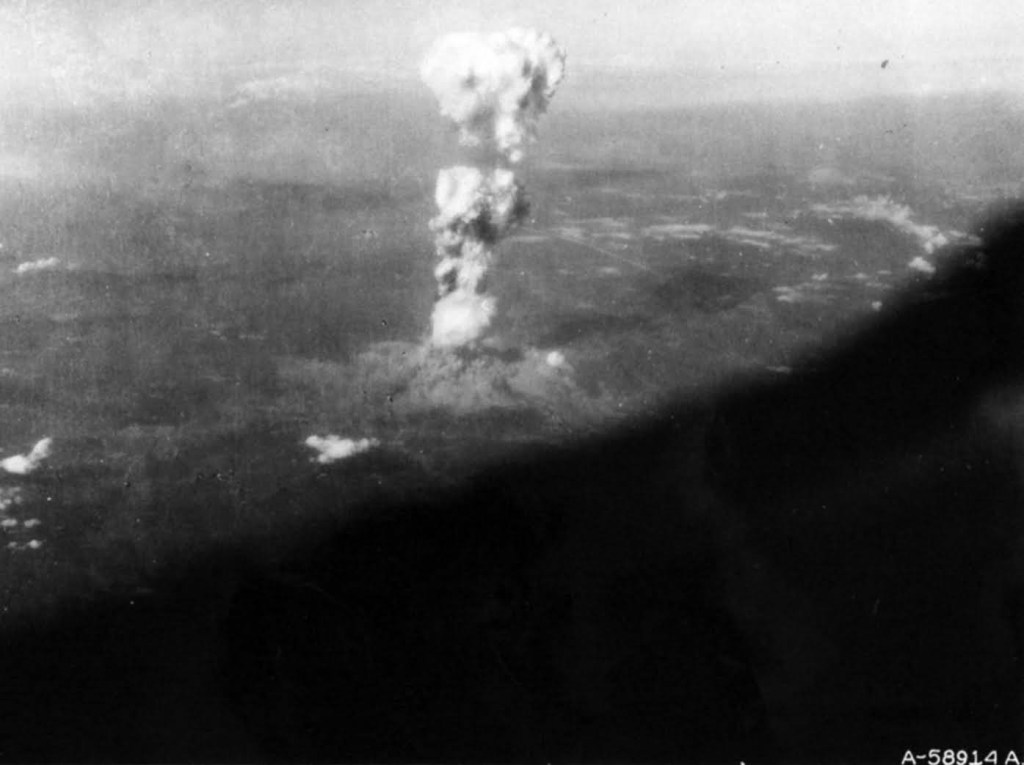
“A mushroom cloud rises over Hiroshima after the atomic bomb exploded at 9:15 AM on August 6, 1945. Photo by the Library of Congress” -nationalww2museum.org
Hideko Tamura Friedman was ten years old living with her family and Hideyuki, who she saw as a younger brother more than a cousin, in Hiroshima on August 6, 1945. This terror initially seems to be in the past, but war crimes and genocides of the present day certainly come to mind with Friedman’s retelling of life in Hiroshima during the Second World War.
“Tokyo was firebombed, and my Aunt Kimie was burned to death . . . Air raid sirens went off day and night. All of our clothes had labels sewn in with our names and addresses” (Friedman 4).
Hideko Tamura Friedman
This level of cruelty was shocking and new in the world’s previous view of warfare; nowadays, several countries exist in this state of terror and worse. Since the end of World War 2, how have such extreme actions in warfare come to be normalized? The immorality of America’s decision to drop the atomic bomb on Japan’s Hiroshima and Nagasaki endorsed and initiated cruelty in warfare like what is seen in the present day.
Today, the Defense Department Law of War says “ ‘. . . the overall goal of the state in resorting to war should not be outweighed by the harm that the war is expected to produce’ . . . Leaders must evaluate whether civilian collateral damage in bello [in war] would be disproportionate to the benefit of achieving regime change against aggressor states post bellum [after war]” (Mckinney et al. 5).
President Truman seemed to agree with this when he announced the atomic bombings in Japan as an alternative to the estimated 750,000 to 5,750,000 total casualties in the event of an Allied invasion. The new atomic bomb was dropped and the US estimated 110,000 casualties, thus declaring the bombings as a lesser evil. (Messer 2) These are findings, pulled from Robert L. Messer’s paper in the Bulletin of the Atomic Scientists, that were published entries from Truman’s diary at the time of his decision. They argue for Truman’s responsibility to the American and Allied countries’ citizens. Truman further supports himself and says that the attack was necessary, “ ‘. . .to destroy Japan’s capacity to make war’” (Messer 1). Hiroshima and Nagasaki had been described as military bases and justified targets as they truly did hold military ports, headquarters, and warplants. Supporting this, the Japanese Emperor and his country were dettered along with the entire world from any further conflict, as seemed the goal of using the bomb. Mats Andren from the University of Gothenburg, Sweden, examines three transnational European intellectuals of the time and their views on the atomic bombings. All three persons agreed that “ . . . the atomic bomb spurred something akin to a world-consciousness well before the environmental movement of the 1960s and 1970s, which is often cited as the source of this kind of thinking” (Andren 13). One of these men, Denis de Rougemont, even believed the bomb to be a savior;
“For only the Bomb can rid us of armies, national sovereignties, and the anarchy that maintain on the planet. I aver that the Bomb can save us in two ways: either by blowing up everything or by forcing us shortly to unite humanity above and beyond nations. You need a planetary threat in order to provoke a sacred union of mankind” (Andren 6).
Although optomistic and ideal, the thinking of these non-governmental men does not hold proportional to the thousands of innocent Japanese citizens dead from the atomic bomb. Messer’s report addresses the shortcomings in the justifications of the bomb’s use, “It can be argued that ending the war sooner rather than later, even a few days later, by whatever means at his disposal was Truman’s first responsibility. It also can be argued that limiting Soviet expansion in Asia, as a bonus to ending the war as soon as possible, was in the US national interest and therefore also Truman’s duty. But the point here is that the president, in publicly justifying his use of the bomb, never made those arguments” (Messer 7).
Not only what the president didn’t use to justify Japan’s bombings but what he did use emphasizes the injustice of his decision and its effects. As previously mentioned, Truman claimed the cities to be military bases. Truthfully,
“ . . . the radius of destruction of even those first generation 13-kiloton bombs far exceeded the size of any ‘military base.’ Casualty figures varied greatly but all showed that the overwhelming majority of those killed and wounded were civilians in their homes, not soldiers or war workers on the assembly line” (Messer 1).
Robert L. Messer
The bomb’s targets were chosen inhumanely and for a factor of mass destruction and shock but also for Truman’s want of the final word and consequently more power for the US. The knowledge of the Soviet Union’s entry being able to replace an Allied invasion to end the war with the possibility of fewer casualties didn’t seem to influence the American President. To reference Messer again, “ . . . the issue was no longer when the war would end, but on whose terms . . . The bomb would shorten the war by days rather than months. Its use would not save hundreds of thousands of lives—but it could save victory for the Americans” (Messer 6). The world moved into a new age by the flight of one plane and one carry-on; Roosevelt took his world and country that survived the Great Depression through brotherhood and morality to the grave with him. World leaders no longer hear the American President say that “The measure of the restoration lies in the extent to which we apply social values more noble than mere monetary profit” (Roosevelt 1). Mass murder in the way of atomic bombings does not justify the President’s monetary gain for his country.

“Palestinians carry an injured man following the Israeli bombing on Khan Yunis, south of the Gaza Strip”-The Lucie Awards; photo by Saher Alghorra
David A. Andelman of the World Policy Journal says that “We Americans believe in the sanctity of our nuclear deterrent, in part, because it is the only ultimate gurantor of our survival” (Andelman 3). In his writing, Andelman highlights a fear of Armageddon or the end of the world; this fear has not been forever present in America and now has been self-instigated by ourselves. Franklin D. Roosevelt; the last president of the United States to exist in a non-nuclear world famously proclaimed “ . . . the only thing we have to fear is fear itself” (Roosevelt 1). In a state of fear, the snake coils and lunges at its aggressor; the bite: the atomic bomb, its venom: 70,000 instant casualties. A Journal of Social Justice published Ronni Alexander’s thoughts about the bombings of Hiroshima and Nagasaki at the age of 75, he concludes “ . . . how our fear reconstructs the need for protection through military and perhaps nuclear means” (Alexander 3).
What the American people of 1945 and now misunderstand is the sense of security created by an atomic bomb is false and counterproductive. The President of the International Committee of the Red Cross echoes these legitimate inconsistencies with the proposal of nuclear policies to promote peace: “ . . . weapons that risk catastrophic and irreversible humanitarian consequences cannot seriously be viewed as protecting civilians or humanity as a whole” (Maurer 5). This weapon, born out of fear, has already killed hundreds of thousands of civilians therefore disproving the notion of the bomb promoting security. This relates to personal and moral levels as well as physical loss—Brandon Shimoda recorded his feelings and recollections when visiting Domanju, a monument that teaches about the Hiroshima and Nagasaki bombings. An estimated 69,185 out of 70,000 people remain unnamed from the ashes of the atomic bomb
“ . . .if it was or is possible to enumerate lives from their ashes—include the namelessness that was one of the effects of the bomb: the extermination of life, the extermination of both the corpse and the name of that life. What are the nameless people’s names? If we knew their names, what would we do with them? We could begin to imagine the sound of their names being spoken by people who loved them” (Shimoda 6).
Brandon Shimoda
Fear heard in the over 70,000 screams of loved ones transcended from the American fear of being beaten by the Soviet Union that manifested into a world destroyer. A witness of Los Alamos and the final test of the atomic bomb, BainBridge, quotes in his report: “ . . . the remote possibility must always be considered that the energy once liberated will be completely uncontrollable and by its intense violence detonate all neighbouring substances” (Aston qtd. by BainBridge 5).
Everyday since August 6, 1945 has held a new horror that pushes humanities’ desentization to immoral levels. Last summer saw the release of the decorated and praised biography of J. Robert Oppenheimer, father of the atomic bomb. The movie ends in a powerful conversation between Einstein and Oppenheimer, “Albert . . . when I came to you with those calculations, we thought we might start a chain reaction that would destroy the entire world? . . . I believe we did it” (Nolan 2:53:00-22:54:08). One may describe destroying the world as a single bomb killing a million people and invoking fear in the rest; the world knows this fear today as conflicts in Gaza and Ukraine grow. Time magazine highlights a Gaza native who has been photographing his home; “Alghorra’s photographs show . . . Families [grieving] next to lifeless bodies.-“
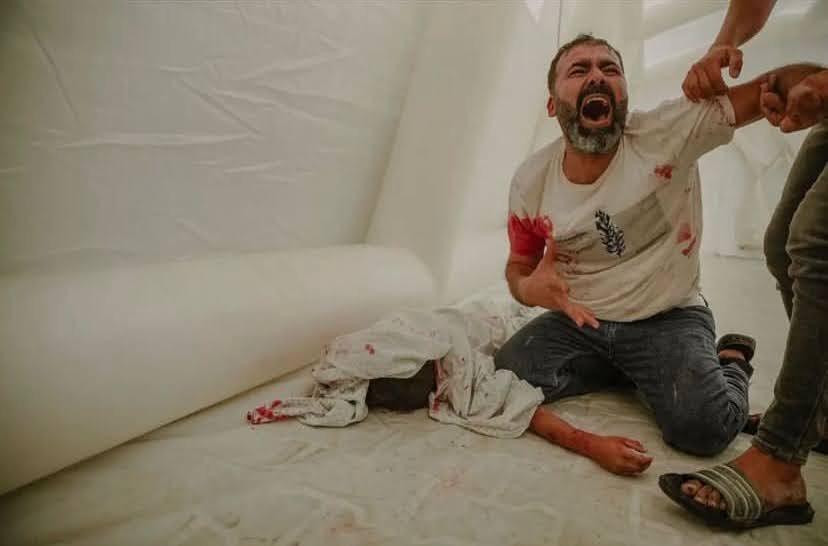
“Omar Lafi grieves on Oct. 9 by the body of his nephew who was killed by an airstrike”-TIME magazine; photo by Saher Alghorra
“-Plumes of smoke fill the sky. Rubble fills the streets. A mother, injured after her house was hit by an airstrike the morning of Oct. 9, cries as she learns that her daughter has died” (Kang 2). Man-made rains of metal and bombs in Gaza is not the only inhumane event of the modern day as Russia continues to harass Ukraine and their people. The Distinguished Advisor of the National Security College of New South Wales, James Renwick, endeavored to argue on the legitimacy of Russia’s war crimes relating to the aforementioned conflict. Deciding Russia’s guilt, he states:
“They have committed depravities, crimes against humanity without any shame or compunction. They’ve targeted civilians with death and destruction. Used rape as a weapon of war. Stolen Ukrainian children in an attempt to . . . steal Ukraine’s future. Bombed train stations, maternity hospitals, schools, and orphanages” (Renwick 3).
James Renwick
Gone are the days of President Roosevelt’s policy of the good neighbor since his successor and Vice President dealt an atomic “mastercard.” The Bulletin of the Atomic Scientists provides an article by Richard Turco, similar to Oppenheimer’s perceived chain reaction at the end of the 2023 biography, he says;
“Nuclear weapons [have] been released onto the world stage, and they [will] not go quietly away. You cannot ‘dis-invent’ them . . . it is amazingly easy to construct weapons of mass destruction (WMD). The knowledge—stolen, bought, or shared—has led overtime to new nuclear weapons states that seem more unstable and uncertain than earlier ones, especially North Korea, but also Pakistan, India, and Israel” (Turco 2).
As a country that has been considered an idol or example, the US initiated and continues to condone the cruelty of bombing and killing innocent children and civilians for other nations to imitate. Power dynamics between the powerful and powerless control the way the world spins; “The atomic bombings were the greatest display of how easy it is to totally destroy a country, its people, the environment, and disrupt a society for decades afterwards” (Samler et al. 2). A Journal of Social Justice’s Danielle Samler and Christian N. Ciobanu write about the lasting effects of the Hiroshima and Nagasaki bombings; the acknowledgement of an all powerful control, leader, or in this case: weapon. A similar representation of such a power dynamic can be seen in Jacob Lawrence’s Confrontation on the Bridge; a colorful and geometric depiction of Bloody Sunday. The brutality and all controlling force of the police is one singular wolf snarling at the group of peaceful protesters, Bloody Sunday was a gruesome and horrific day filled with hate crimes and absolute terror. For the source of their fear to be one aggressive wolf, Lawrence clearly demonstrates the power each group held in their own right even in a large group or solo. As one wolf can do so much damage, so can one atomic bomb. The world of the atomic age is one of cruelty and inhumanitarian warfare. As the President of Turkey said as he condemned the massacre and genocide in Gaza at the hands of Israel:
“These are the ones who know how to kill well. Yesterday, they were strangling eachother, they were exterminating Jews in gas chambers, they were erasing cities from the atomic bombs they dropped . . . the same mentality is now in Gaza . . .We saw these cruelties, these atrocities . . . That’s why Gaza is not just the issue of those who are struggling to hold on to life there, it is the issue of all of us” (Erdogan 2).
Recep Tayyip Erdoğan
Works Cited
Alexander, Ronni. “Reflecting on Hiroshima/Nagasaki at 75.” Peace Review, vol. 32, no. 3, July 2020, pp. 325–31. EBSCOhost, https://doi.org/10.1080/10402659.2020.1867349.
Andelman, David A. “Onward to Armageddon?” World Policy Journal, vol. 26, no. 3, Fall 2009, pp. 115–21. EBSCOhost, https://doi.org/10.1162/wopj.2009.26.3.115.
Andren, Mats. “Atomic War or World Peace Order? Karl Jaspers, Denis de Rougemont, Bertrand Russell.” Global Intellectual History, vol. 7, no. 4, Aug. 2022, pp. 784–800. EBSCOhost, https://doi.org/10.1080/23801883.2020.1830494.
Bainbridge, Kenneth T. “1975: All in Our Time: A Foul and Awesome Display.” Bulletin of the Atomic Scientists, vol. 76, no. 6, Nov. 2020, pp. 374–80. EBSCOhost, https://doi.org/10.1080/00963402.2020.1847493.
Friedman, Hideko Tamura. “1995: Hiroshima Memories: One Sunny Day, a Young Girl Learned about Darkness.” Bulletin of the Atomic Scientists, vol. 76, no. 6, Nov. 2020, pp. 397–403. EBSCOhost, https://doi.org/10.1080/00963402.2020.1847508.
Kang, Sangsuk Sylvia. “Seeing Gaza.” TIME Magazine, vol. 202, no. 15/16, Nov. 2023, pp. 45–47. EBSCOhost, search.ebscohost.com/login.aspx?direct=true&db=asn&AN=173208815&site=ehost-live.
Lawrence, Jacob. Confrontation on the Bridge. 1975.
Mansoor, Sanya, et al. “Inside Gaza’s Hospitals.” TIME Magazine, vol. 202, no. 17/18, Nov. 2023, pp. 7–9. EBSCOhost, search.ebscohost.com/login.aspx?direct=true&db=asn&AN=173511945&site=ehost-live.
Messer, Robert L. “New Evidence on Truman’s Decision.” Bulletin of the Atomic Scientists, vol. 41, no. 7, Aug. 1985, pp. 50–56. EBSCOhost, https://doi.org/10.1080/00963402.1985.11455999.
McKinney, Katherine E., et al. “Why the Atomic Bombing of Hiroshima Would Be
Illegal Today.” Bulletin of the Atomic Scientists, vol. 76, no. 4, July 2020, pp. 157–65. EBSCOhost, https://doi.org/10.1080/00963402.2020.1778344.
Nolan , Christopher, et al. Oppenheimer . Universal Studios , 2023.
“Nuclear Weapons: Ending a Threat to Humanity.” International Review of the Red Cross, vol. 97, no. 899, Sept. 2015, pp. 887–91. EBSCOhost, https://doi.org/10.1017/S1816383116000060.
Renwick, James. “The Russia/Ukraine Conflict — Developments in War Crimes.”
Journal & Proceedings of the Royal Society of New South Wales, vol. 156, no. 2, July 2023, pp. 264–80. EBSCOhost, search.ebscohost.com/login.aspx?direct=true&db=asn&AN=174399101&site=ehost-live.
Roosevelt, Franklin D. “Inaugural Address.” Collegeboard.Org, 1933.
Samler, Danielle, and Christian N. Ciobanu. “Waking Up Generation Z.” Peace Review, vol. 32, no. 3, July 2020, pp. 332–41. EBSCOhost, https://doi.org/10.1080/10402659.2020.1867350.
Shimoda, Brandon. “Domanju.” Massachusetts Review, vol. 59, no. 4, Winter 2018, pp. 693–98. EBSCOhost, https://doi.org/10.1353/mar.2018.0119.
Turco, Richard. “Nuclear Foreboding: Shadows Cast by Nuclear Winter.” Bulletin of the Atomic Scientists, vol. 73, no. 4, July 2017, pp. 240–43. EBSCOhost, https://doi.org/10.1080/00963402.2017.1338017.
“What Is Happening in Gaza Is Not Defense, It Is an Open and Vile Massacre.” Vital Speeches of the Day, vol. 89, no. 12, Dec. 2023, pp. 284–86. EBSCOhost, search.ebscohost.com/login.aspx?direct=true&db=asn&AN=173873005&site=ehost-live.
 Oratorically
Leave a comment