
America is a nation of immigrants; from Hollywood to the national banks, the American Dream was born not from the slumber of generational citizens, but from the innovation and perseverance of immigrants who make America great in both culture and economy.
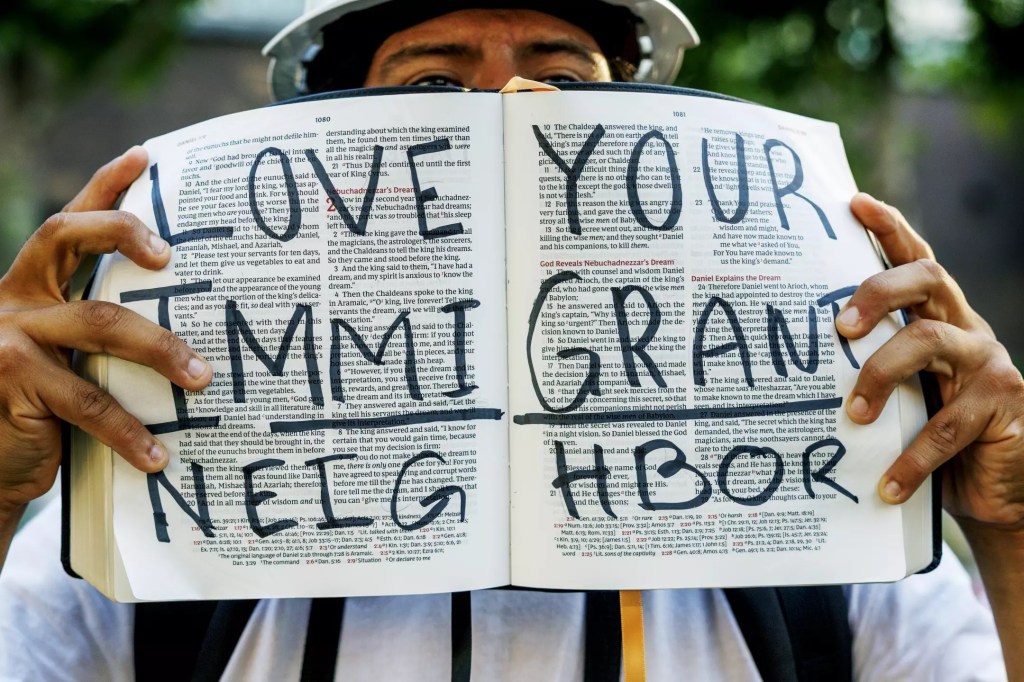
Jonathan Amado, 30 holds a Bible with the words “Love Your Immigrant Neighbor” written on the inside pages during a prayer vigil at Grand Park on Tuesday. (Gina Ferazzi / Los Angeles Times)
The Trump Administration’s recent ICE raids and anti-immigration actions beg the question: Is the goal to lower crime rates or all immigration rates? With high-profile arrests, such as those of Tufts and Columbia students Rümeysa Öztürk and Mahmoud Khalil, respectively, and the crackdown on student visa requirements that includes social media checks, the United States appears not only to have a difficult customs process but also to be an unappealing place for international students and individuals.
The president’s White House site formally posts that “The objective in each HSTF is to end the presence of criminal cartels, foreign gangs, and transnational criminal organizations throughout the United States, […] and ensure the use of all available law enforcement tools to faithfully execute the immigration laws of the United States.” To house these criminals, the administration built “Alligator Alcatraz”, a tented detention center that is supposed to hold the worst of the worst. However, according to information from the Miami Herald, hundreds of these detainees have no criminal charges, and some aren’t even immigrants but natural-born citizens of the US. In April of this year, the president gave his opinion informally on his X page, “Sleepy Joe Biden, THE WORST PRESIDENT IN THE HISTORY OF THE UNITED STATES, has allowed millions and millions of Criminals, many of them murderers, drug dealers, and people released from prisons and mental institutions from all around the world, to enter our Country through it’s very dangerous and ill conceived Open Border.” Seeming to address the national public outcry with, “Sorry, but it’s my job to get these killers and thugs out of here. THAT’S WHAT I GOT ELECTED TO DO. MAGA!”

Photo credit: JIM WATSON/Getty Images
After taking office, the tweeting (X-ing?) president delivered on his promise and even broke the ICE arrests record for a single day as of June 9th. During this time, protests in the largely immigrant-populated city, Los Angeles broke out against the government’s new policies. Senator Cory Booker said that “A lot of these peaceful protests are being generated because the president of the United States is sowing chaos and confusion by arresting people who are showing up for their immigration hearings, who are trying to abide by the law.” Closer to the conflict, an LA “[…] City Councilmember Ysabel Jurado said that a Friday raid at a warehouse in the Fashion District ‘was not about public safety, it was fear driven, state violence designed to silence, to intimidate, to disappear.’”
Fox News drives it home, saying: “The new policy is likely to lead to a spike in deportations of migrants who have not committed crimes aside from crossing the U.S.-Mexico border illegally.” The policy refers to arresting immigrants at their hearings and deporting them without a trial. Anti-immigration and strong isolationist views drove the third Trump campaign all of last year and seemed to be winning points for him, but is this hostile attitude towards immigrants a winning point in the long term for America as a nation and for her people?
Economically, times of high immigration rates are the most profitable. In the 1990s, “[…] and especially in the second half of the decade, the national unemployment rate fell below 4 percent and real wages rose up and down the income scale during a time of relatively high immigration.” Many scholars point out that immigrants tend to fill jobs that American citizens are unwilling to do, especially manual labor positions that are vital to any community.
Although the average American associates immigrants with these lower-class jobs, it is also true that many immigrants or second-generation children will go on to make up the majority of the scientists and engineers in the US. In 2012, the Obama administration’s White House website posted ten ways immigrants boost the economy, “According to the Census Bureau, despite making up only 16 percent of the resident population holding a bachelor’s degree or higher, immigrants represent 33 percent of engineers, 27 percent of mathematicians, statisticians, and computer scientist, and 24 percent of physical scientists. Additionally, according to the Partnership for a New American Economy, in 2011, foreign-born inventors were credited with contributing to more than 75 percent of patents issued to the top 10 patent-producing universities.” The most famous scientist of the modern day, Albert Einstein, was an immigrant from Germany; in fact, over a third of American scientists that received Nobel Prizes from–1994 to 2004–were immigrants. With such a record, it is a mystery as to why Donald Trump’s GOP Platform makes a point to “[…] prioritize Merit-based immigration […and] end Chain Migration, and put American Workers first!” From the odd capitalizations to the incorrect implication that immigrants steal American jobs without qualifications, it is clear that the Trump administration hasn’t done its research on the social and economic benefits of immigration.

The very essence of America is immigration: America is a nation of immigrants. This idea is often criticized, saying that “Every nation and people group around the world and throughout history have been nations of immigrants. For every country at some point was an uninhabited, uncultivated, and barren piece of land to which migrants had to move and settle, cultivate and develop, and reproduce in order to create a people and then a nation.” This point, made by the Phd candidate Ben R. Crenshaw, is not incorrect, but this is not what makes America a nation of immigrants. The United States was relatively late to the game in comparison with Great Britain and other First World countries. The foundation of American values and identity came at a time when most ideas were already deeply embedded and rooted in other world cultures. Charles Hirschman explains this expertly in his journal article “The Contributions of Immigrants to American Culture,” published by The MIT Press in 2013: (excuse the long quote)
“Unlike many other societies, the United States does not have an identity tied to an ancient lineage. Given the two wars against the British in early American history (in 1776 and 1812), the founders of the American republic did not make English origins the defining trait of American identity. Being American was defined as acceptance of the Enlightenment ideas expressed in the founding documents of the Declaration of Independence, the Constitution, and the Bill of Rights. Even though these ideals have been belied by the continuing stain of slavery, civic identity, rather than ancestry, has been the distinctive feature of American “peoplehood” from the very start. This trait, combined with jus soli (birthright citizenship) has slowed, if not stopped, efforts to define Americans solely on the basis of ancestral origins. Another reason for the broad definition of American identity is that the overwhelming majority of the American population, including white Americans, is descended from nineteenth- and twentieth-century immigrants.”
As Hirschman explains in the provided excerpt, being American doesn’t depend on nationality or ancestry but on ideas and a certain spirit to innovate and achieve.
Beyond the definition of what it means to be an American person, American culture is also entirely immigrant-centric. Classic Americana movies, theatre, and food are all the work of other cultures or foreign-born immigrants. To quote Hirschman again, “Historian Donna Gabaccia argues that traditional American cuisine is a Creole mix that reflects influences from the three major founding populations of indigenous American Indians, Europeans, and Africans. Over the last century, immigrants from Germany, Italy, Greece, Lebanon, China, Japan, and India have all left distinctive culinary marks on what Americans eat in restaurants and in their homes. Ethnic foods have become American foods, and even American fast foods.” The American hot dogs and hamburgers originate with German sausage makers, and diners were often owned by Greeks.

It is common knowledge that the blues and jazz came from African American influences in New Orleans, New York, and Chicago areas, but even the songs you sing at Christmas came from immigrants. To continue the Hirschman theme, “Irving Berlin, who was born as Israel Baline in Russia, wrote ‘White Christmas,’ ‘Easter Parade,’ ‘God Bless America,’ and numerous other standards. Many of the most highly regarded composers and playwrights of Broadway were the children of immigrants, including George and Ira Gershwin, Richard Rodgers, Lorenz Hart, Jerome Kern, Harold Arlen, and Leonard Bernstein. These composers and lyricists were largely second- and third-generation Jewish immigrants who were reared in ethnic enclaves; but their work has defined the quintessential American musical culture of the twentieth century.” If there is music, there must be dance: some of the most iconic Broadway sequences were choreographed by immigrants, including the legendary dance fights from West Side Story. “[…] Michael Kidd (Michael Greenwald), Jerome Robbins (Jerome Wilson Rabinowitz), and Helen Tamiris (Helen Becker). […] all children of Russian immigrants, received one-third of all Tony Awards for choreography between 1947 and 1973.” All this to say, the American identity is soul over skin or passion over ancestry. The thought of an American citizen conjures (or should conjure) the image of a driven, friendly, and free person and not the image of a race or common language; that is why the UK or China (etc.) cannot boast being a nation of immigrants, because the American experience and identity transcends beyond citizenship and legalities.
Policy is a touchy subject, and I will not pretend to know the solution or correct changes to make, but although policy can be an exclusive subject reserved for the politicians and people in the know, the real-world effects can be understood by all. The Trump Administration’s anti-immigration rhetoric and actions have been racist, an abuse of power, and un-American. More than the future for immigrants is at stake; the future of America and what she stands for is being threatened by hateful, ignorant people. To conclude, a quote from Daniel Griswold in the aftermath of September 11th: “It would be a national shame if, in the name of security, we closed the door to immigrants who come here to work, save and build a better life for themselves and their families. Immigrants come here to live the American Dream; terrorists come to destroy it. We should not allow America’s tradition of welcoming immigrants to become yet another casualty of Sept. 11.” or a casualty of any presidential administration.
 Oratorically
Leave a comment